1D Minesweeper
Submit solution
Points:
1
Time limit:
1.0s
Memory limit:
256M
Author:
Problem types
Allowed languages
C, C++, Java, Python
1D minesweeper is a game played on a grid, where players try to find the location of all the hidden "mines". Each grid cell contains one of the following:
- A dot (
.), indicating that the cell is empty and has 0 adjacent mines. - A digit (
X), indicating that the cell is empty and has exactly X adjacent mines. - A hash (
#), indicating that the cell contains a mine. - A question mark (
?), indicating that the contents of the cell are unknown.
Given a 1D minesweeper board, what is the minimum number of mines it can contain?
Input
The first line contains a single integer (
), the number of cells in the 1D minesweeper board.
The second line contains a single string (
) the state of the 1D minesweeper board. The board only contains the above characters, and is always a valid game state (e.g. you cannot have
#1#, as the 1 would be incorrect).
Output
Output the minimum number of mines that can be on the 1D minesweeper board with the state given.
Example
Input 1
10
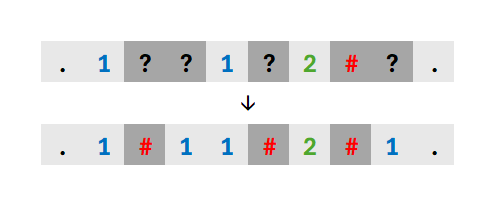
.1??1?2#1.
Output 1
3The mines can be placed in the 1D minesweeper board as shown below:
Input 2
11
.1?1.?1..1?
Output 2
3Input 3
10
?1.1?2?2?.
Output 3
4
Comments